Showing posts with label Nick Clegg. Show all posts

Saturday, 26 March 2011

The Fall of Nick Clegg and Cleggmania.

As regular readers of this blog might be able to tell, I am not much of a fan of Nick Clegg.  For me he has represented everything that is wrong with British politics.  Pragmatic without principle, a leftist presenting himself as a centrist, and with a whole bunch of screaming lefty cronies supporting him with mindless slogans and useless superlatives.

I was therefore horrified when Cameron's Conservatives united with Clegg's Liberal Democrats in order to form the present coalition government back in 2010.  As I have seen Clegg's popularity fall after that coalition, it has buoyed me somewhat that I was right after all, and that people have seen through the media image to view the festering pragmatist that lurks underneath.  It is this subject that I cover in my latest article for the Grapevine.

"It seems like such a long time since Cleggmania. Just think, it was less than a year ago that vast swarms of students and other trendy political types were jumping around, shouting about how they “agree with Nick”, that he was the future of politics, and how he represented a bold new middle ground between those satanic Tories, and outdated Labour.
Yet less than a year later and Cleggmania has not only faded away, it has plummeted like a lead balloon. The Liberal Democrats, once a party with over 30% support, now has its popularity in single digits according to some polls, and last week’s by-election in Barnsley was an unmitigated disaster that indicates that things are only set to get worse, not better for the once innocuous third party.
Things are not going much better for their “charismatic” leader either. Polling in Clegg’s constituency shows that there is a very real chance that he could be ousted at the next election. Should such a thrashing occur, it would be a Portillo moment of the kind that those of us on the right would relish in the same way we relished the ousting of Jacqui Smith in 2010.
Yet it is possible that the rejection of Cleggles is not just the public getting bored with a public figure, it is also the rejection of the “pragmatic” approach to politics that Clegg and many other politicians represent.
For Cleggmania did not fade out with the public getting bored of him; instead it died when he turned his back on the principles that he claimed to hold. His agenda in the election was firmly left wing, and by uniting with the Conservative Party, he showed that he would happily chuck that agenda if it suited his quest for power, and would drop key manifesto promises if it got him closer to Downing Street.
However, those of us on the right should not get too smug about the fall of Cleggmania. David Cameron is the same sort of politician, who has also sacrificed a great deal in order to gain power and push through an agenda that has tried to please everyone but has satisfied no-one. In the name of “pragmatism” and with vague superlatives about “common ground” and “the good of the nation”, we now have a coalition government based on few principles if any.
The fall of Clegg should not be seen just as the destruction of the Liberal Democrats – a party that has for too long tried to avoid solid principle in favour of jumping on whatever bandwagon comes along. Instead, it should be seen as the public’s rejection of the politician who abandons his principled convictions for some misguided pragmatism...."
The rest of the article can be read here.

Sunday, 26 December 2010

"Principles? We Don't Need No Stinkin' Principles" says Senior Tory Minister

Well, I had a day off from all news stories yesterday, choosing instead to enjoy the festivities with my family and to play around with my new Kindle.  Today I woke up very relaxed, turned on my PC, checked the stories on the Daily Telegraph and immediately my blood pressure hit the roof - back to business as usual here at the Anglo-American Debate then!

Today's story is not a complete surprise, and is from an unnamed source (and so needs to be taken with a pinch of salt) but it does show how the end of the Conservative Party in Great Britain as we know it is a very real possibility, and true conservatives who want their party to represent real conservative values as opposed to some fuzzy liberal-left consensus should be very worried indeed!

In short, the story (found here) from the Daily Telegraph, reveals that a "senior Conservative minister" has backed proposals to field "coalition" candidates at the next election.  To clarify, this would mean that the Tories and the Lib Dems would get together and decide upon a candidate that they could both agree upon to run under the banner of "Coalition candidate."

Of course this is absolutely ideal for the left-wing of the Tory Party (a scandal that such a thing even exists) who can select the most left-wing candidate that they like, a candidate who has as much to do with conservatism as I do with the Trotskyites, and then when questioned on it can turn around and say "Oh, well we needed to in order to satiate the Liberal Democrats."  It gives them the perfect excuse to make a permanent coalition with the Liberal Democrats (after all, which party would the coalition candidates actually belong to?), meaning that they could drag the Tories away from the Right, and into the arms of a centre-left coalition with the Lib-Dems.

I can see exactly what a "Coalition" candidate would be - some trendy Cameroon trained in media relations and spin who would stand for "fairness", "equality" and "a new way of doing politics in the 21st Century."  Great...

Such a decision would be a disaster for the right-wing of the Tory Party, of which I am a part, and needs to be prevented at all costs.  The Party is already too far left as it is, and to unite with the Lib Dems would mean little more than a complete rejection of all conservative principles in order to solidify power in the short term.  But voters are not stupid, they would be able to see this for what it is.  They would know that the Conservatives would no longer stand for anything.  It isn't "compromise" or "dialogue" or any of the other fuzzy words that weirdo like Ken Clarke (who I would propose is the "senior Tory Minister" that has approved this) - instead it is a cynical ploy for power, and proves once and for all that the present Tory Party is just a party that will say anything in order to achieve short term power.


This is not what voters want, and will turn people off politics, and will throw them into the arms of Labour on one hand, or UKIP on the other.  While I have no inherent problem with UKIP, I do not believe in splitting the right-wing vote.  In order to win, the right-wing need to unite under one party, ideally the Tories.  But making a permanent principle-less coalition with the Lib Dems will force many of the right-wing of the party out, and will force a split.  While in the long term this may lead to the establishment of UKIP as a major political force (it would certainly be where I would begin to drift) in the short term it would be an absolute disaster.  The left-wing of the Liberal Democrats are already beginning to migrate to the swelling ranks of the Labour Party, the right of the Tories would drift to UKIP, and it would leave a starved Coalition and hand the next election (whenever that may be) to Labour.

Ed Miliband cannot win an election on his own, but if this tasteless coalition continues, then the Tories could very easily lose it, and Miliband may find himself handed the next election by a Tory Party determined to abandon its principles and self destruct at all costs.  The prospect of Prime Minister Miliband should spur the right wing of the Tory Party into action and to reclaim the party from nutjobs such as Ken Clarke - who are determined to continue this marriage of inconvenience with the Liberal Democrats.

It is time to stop the madness.

Tuesday, 21 December 2010

Cable - "I Can Bring Down the Government" - SACK HIM!

The big news coming from the British press this morning is the secretly taped conversations with Business Secretary Vince Cable.  In the conversations (which are actually more like one-sided rants from Cable), The Lib Dem shoots his mouth off to a bunch of people who he thought were Liberal Democrat supporters (but who were actually journalists), and tells them that he has "the nuclear option" whereby if he was pushed to do something he didn't like then he could "bring down the government."  Good one Vince you blithering idiot!

Vince Cable is easily one of the most odious men in politics.  His views are absolutely hard-left and out of the socialist playbook, and the fact that he has managed to get himself the position of Business Secretary in a government that is made predominately of Conservatives is disgraceful.  Yet this shows him up for who he really he is.  He isn't just a socialist - he is a power nut to boot.  In the context of the conversations, Cable is not telling his "supporters" about how the government works, but is simply bragging about how much power he has.

The incident shows that he has no qualms about slagging off the government of which he is a major part either.  He had met these people for the first time, and already he is slagging off the Tories, and how they are going to break their promises in the future, and how he doesn't trust a single one of them.  It raises the question - what would he have said to them the next time they met?

Ultimately though this is a question of power, and Cable's love for it.  Vince Cable is all about power.  All the lefty rhetoric that he spouts about punishing banks, taxing  and beating up bankers is all about transferring power over economic matters away from the banks and into his office.  Cable is a classic statist, and sees himself as the ideal man to run such a large statist economy. There is certainly the usual anti-business mentality present in Vince Cable, but it is power that this man really seeks.  No policy he has ever promoted has ever been about anything other than taking power away from private individuals and organisations, and handing that power over to the State.  He should never have been allowed to even get a sniff of government, and to make him Business Secretary was obscene.  Consequently, we are now facing the consequences of that extraordinarily misguided decision by the Prime Minister.

So, can Cable bring down the government?  In short, no - he is a moron who thinks way too highly of himself, as most statists do.  What he is though is a dangerous moron, and if he is allowed to continue being a moron, and advancing such ridiculous policies like taxing the banks out of existence, then he could  be a danger in the future.  It is for this reason that Cameron and Clegg should demand his resignation before the year is out.  Let's start 2011 Cable-free!

Wednesday, 20 October 2010

Britain's Spending Cuts - Inconsistent!

With France having exploded into rioting over the last week over the extension of the retirement age from 60 to 62, we have seen similar outrage today in Britain as Chancellor George Osborne has announced what are, for the most part, pretty meagre cuts.

Do not be mistaken by the Left's rhetoric, these spending cuts are not strong enough, but they are a start.  The Financial Times for instance is trying to paint these as some sort of mega cuts, but 4.5% cut over 5 years isn't exactly earth-shattering  But, with a strong left-wing movement in Britain, as well as the hard left Liberal Democrats having significant influence in the new government, the current cuts are really all that are politically feasible.  And I believe that on the whole, these cuts will work out well for the Coalition.  It will restore at least some confidence to the markets, and possibly to job creators too, in spite of the tax increases that will hit over the next few years.  Personally, I would have liked to see more cuts to welfare, cuts and reform to the NHS (which has remained untouched), less cuts to the military and less tax increases (which will only prevent growth).

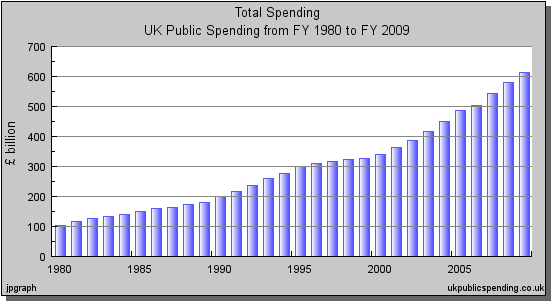
I have an article coming out over the next few days which specifically cover the military cuts, but in the mean time I would like to focus on something that caught my eye that not many media outlets have picked up on.  We have seen that NHS spending has been ring fenced, and this has been debated by many.  But, today it was announced that International Aid has been increased by a stunning 33% and Climate Change funding (whatever the hell that consists of) has been increased by a hefty 18% - you can find an easy to read graph of all the cuts etc here.

Now, I'd be pretty annoyed had they not been cut, but for the budgets to be increased!?  It is quite clear that this is a total fop to the Liberal Democrats.  No conservative with any understanding of immigration would support a massive international aid budget.  The only way to get countries out of poverty is to encourage market growth, not to support big government programs and fund state sponsored dictatorships.  There is no country that has been lifted out of poverty by international aid, not one.  In addition, when you are giving some of that aid to India - a nation that has its very own nuclear weapons program - you know your policy is broken.  Yet this is not being tackled.

Climate Change - well, unfortunately, whether or not you believe in Climate Change or not, this is nothing more than economic stimulus for supposed "green jobs".  As we have seen in both America and Britain, this doesn't work.  True green jobs, like almost every job, is created by the private sector, not by tax and spend policies subsidising pointless industries.  Again, conservatives know this, left-wingers don't, so why on Earth have we increased the budget?

The spending cuts tell us a lot about the strength of this coalition.  It shows that they have managed to get spending cuts through, but they have had a hell of a lot of compromises to make to the left in order to get them through.  Increases in Climate Change budgets and International aid are enormous concessions, as are enormous cuts to the military budget.  In addition, even with these moderate spending cuts, we are beginning to see a massive backlash from vested interests in the unions and public sector - it is not going to be easy

If the Coalition wants to try and push forward a conservative agenda that is going to put Britain back on the right track (so to speak), it is going to have to fight tooth and nail for it, and with the gaggle of "centrist" Tories and hard-left Liberal Democrats, I just can't see how they are going to do that.  


Friday, 1 October 2010

New York Times: To cut or not to cut in Britain?

Apologies for the lack of updates - it was my birthday last week, so the updates have been infrequent.  Back now though!

The New York Times has a peculiar article, where it can't seem to make its mind up on the subject of spending cuts in Britain, but it doesn't prevent the article from being an interesting one in fairness to Hell's Bible.  The title, "Amid Austerity, Britain Keeps Welfare for Well Off."  You smell an agenda?  Me too!

Lets take a look at the article - my comments in red.


LONDON — Every week without fail Lucy Elkin, a comfortably middle-class mother [boo hiss!] of two small children, receives a £33.20 child benefit payment, or about $52, from the debt-plagued British government. [Would they use that term to describe the Obama government?]
“It’s useful and it helps pay the bills, but it is not as if we are struggling to put food on the table,” [Give it back then!!  Don't take it, then bitch about it!] Ms. Elkin said as she led her children from the park to their house on the leafy fringe of Hampstead Heath, one of London’s most desirable neighborhoods.
Ms. Elkin, 40, is a freelance writer. Her husband is a computer programmer. Along with more than three million middle- to upper-income British families, they are among the recipients of £11 billion ($17.2 billion) a year paid to mothers with children here. It is a universal benefit that not only costs taxpayers about twice as much as the total for unemployment payments but also represents the largest chunk of the estimated £30 billion ($47 billion) the government pays each year to Britons with above-average incomes.
“It is one of those things that is quite hard to justify,” Ms. Elkin said. [Agreed, but don't take the benefit.  Also, can you imagine the fuss that lefty papers like the NYT would make if the Tories revoked such a benefit?  Also, I get the impression that people like Ms Elkin would then start moaning about how hard it is, now she doesn't have the "valuable benefit."  Such people moan whatever you do!]
She is not alone in thinking that Britain can no longer afford such generosities. [She is not alone, I agree with her, but then I am not collecting benefits!] But even as civil servants and ministers are preparing to drastically cut most categories of government spending to help close Britain’s budget deficit, the government is so worried about alienating middle-class voters that it is proceeding very cautiously in limiting the subsidy for having children.
“There is a long history of universal welfare schemes here,” [and they have pretty much all failed, just as they are doing in America] said Patrick Nolan, an economist for Reform, a free-market-oriented research organization that has issued a report claiming that as much as 16 percent of total welfare benefits go to those who do not need them. “But it has become a very expensive luxury when hundreds of thousands are losing their jobs.” [Exactly, and lengthy welfare payments cost jobs due to the launch of taxes that such payments require - and taxes costs jobs.]
The debate in Britain highlights an issue that other advanced industrial countries are also beginning to grapple with: Who should bear the burden of the coming wave of austerity? 
Unless politicians are prepared to dig into the pockets of middle- and upper-income families [Excuse me, but I think you will find that that is going on quite enough as it is.], experts say [who?  This is pretty poor reporting], the demands from bond market investors to get government finances under control can be satisfied only by cutting back even further on benefits for the poor and needy [This is silly, what benefits under what circumstances to what people?  "Poor and needy" is vague and political, a weasel word to sneak socialism in most of the time.] But any serious effort to curb long-established middle-class entitlements risks setting off a public reaction that few political leaders are eager to face. [This is true, once you put a benefit in, it is difficult to get it out again.  This is one of the dangers of Obamacare.]
In Britain, the quandary is particularly stark. The social safety net that has been an essential feature of British life [Wrong!  It has been more than a safety net, it is a suffocating duvet, and it only benefits certain groups, AND it not an essential feature - we could live without a great deal of it.  There are many in the middle classes who do NOT get any benefits, but pay through the nose in taxes.] since World War II ended has been built largely on providing similar benefits to all, like health care [Which has been an absolute disaster.  And it does not "provide benefits to all", it forces people to pay for a low standard of healthcare for themselves and for everyone else, if they are lucky to earn anything more than scraps.] and home heating allowances for the elderly, regardless of income. 
Those earning up to £37,400 a year pay income tax of 20 percent per year. [That does not remotely begin to cover it.  As you do and earn more in England, there are so many stealth taxes that nail you. Plus we have a 20% sales tax - wow!  Even New York doesn't have it that high!]
All told, about a third of Britain’s 61 million people claim either a child subsidy or winter heating allowance. [That does not surprise me.]  Together they represent a formidable political bloc of families and senior citizens that Prime Minister David Cameron was loath to alienate during last spring’s election. [Yeah, being soft didn't exactly work out did it?  Now we are in an alliance with the commie Lib Dems]
That helps explain why Mr. Cameron promised not to “means test” the child benefit by limiting it to the poor. He said that payments to the elderly to subsidize television license fees, along with bus fare and heating allowances, would not be touched, either.
Lately, though, the government has begun to signal a harder line.
At the Liberal Democrat’s party conference in September, Mr. Cameron’s coalition partner, Nick Clegg, made the strongest call yet for cutting middle-class benefits, telling delegates that he would be willing to give up the £2,450 ($3,850) in annual child benefits that he and his wife, who is a corporate lawyer, receive for their three children. [Isn't that brave of him?  The problem with Clegg is that he is always looking at a way to punish the middle class - he is the classic socialist.  Now, I don't support giving benefits to anyone but those who actually need it, but I can see Clegg's move as part of a wider attack on the middle class - I have written about Clegg before...]
It remains unclear whether the government will follow through on that suggestion. But there is little question that social protection [or redistribution of wealth], as it is labelled in government accounts, has been the locomotive behind the 53 percent increase in overall outlays, adjusted for inflation, over the last eight years. [Thanks Labour and Gordon Brown!]
This spending spike was driven by previous Labour governments supplying the extra padding to make the British welfare state one of the most accommodating in Europe. [Accommodating isn't the word I'd use.  Bloated, exaggerated, socialist, job-killing, poverty-inducing - use any of those.]
Cuts for the middle class are now on the table throughout Europe, as governments struggle to close budget deficits and reduce debt levels [All while the Bamster keeps increasing deficits and debt levels] that now average 84 percent of gross domestic product. In France, the government is planning to raise the retirement age from 60 to 62; in Greece, public-sector pensions have been sharply cut, and in Ireland government wages have been reduced by more than 10 percent.
But with protests mounting, most governments have said that any further cuts in benefits to the middle class were unlikely. And in the United States, where demands are rising from the right to cut government outlays, none of the advocates have proposed reducing such sacrosanct middle-class benefits as the tax deduction for interest on home mortgages or the tax breaks for pensions and retirement savings. [Scummy.  Tax deductions and breaks aren't spending.  The problem is not how much the governments are bringing in, it is how much they are spending.  To see cuts and breaks in taxes as "spending" assumes that the government has a "right" to how much they normally collect - they have no such right.]
As for Britain, while universal child benefits are common in Europe, total payments to families here — including child tax credits and maternity allowances — are the third-highest among the 33 affluent countries that belong to the Organization for Economic Cooperation and Development, trailing France and Luxembourg. [Not exactly countries we want to be modelling ourselves on, are they?]
The child benefit pays £20 a week to the oldest child and £13.20 for each additional child until they reach the age of 20. The only requirement is that they continue to attend school. [Yes Americans - we bribe our kids to stay in school!  That's how bad it is!]
Research [What research?] shows that, although payments are promoted as a direct and simple means to allay child poverty by putting money into the hands of needy mothers, nearly half of the payments go to families with above-average incomes.
According to a soon-to-be-published study by Ian Walker, an economist at Lancaster University, well-to-do families that received the benefit were more inclined to spend it on themselves, not their children — with alcohol and tobacco among the most notorious substitutes. [Explains why it hasn't worked.]
These findings make a “good case for means-testing the benefit,” Mr. Walker said. “It’s clear that a number of universal benefits look vulnerable.” [All while Obama is trying to increase universal benefits - he really is a bit backward!  NYT fails to notice this glaring conclusion.]
But many poverty experts [which poverty experts are these?] strongly defend universal payments, arguing that, despite the excesses, the largest portion of the money goes to those who really need it and that paying benefits across the board is the best way to preserve political support for such programs. [Yeh - thats a GREAT reason to keep it up!  Who are these whacko 'experts'?  Do they even exist, or is this the NYT going "Trust us!  These are experts!"]
The British government, apart from pensions, pays large sums to the elderly, much of which ends up in the pockets of more affluent citizens. The government spends £2.7 billion ($4.24 billion) a year to provide a winter heating allowance to everyone over the age of 60. It provides £1 billion for free bus passes for those senior citizens and devotes £575 million for complimentary TV licenses for people 75 and older. [Hmm, these aren't exactly the schemes that have been breaking the bank - funny that they focus on these instead of the welfare handouts, the bloated public sector, and the stimulus]
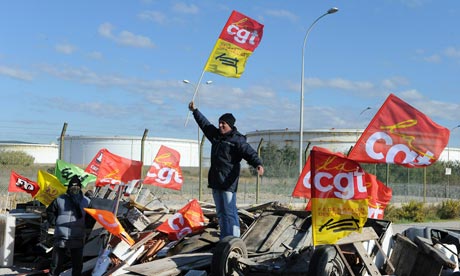
Opposition to spending cuts is already building, and unions [who are full of socialists and communists, and who nearly destroyed the country in the 70's and 80's] across the country are banding together, promising a series of strikes.  They are expected to culminate in a mass protest on Oct. 19, the day before the government makes public its spending review.
Still, while the fear and anger about the coming cuts are certainly palpable here, there are signs that many Britons are reluctantly coming to the conclusion that the fairest way to deal with the need for austerity may be to bring the era of universal largess to an end. [Yes most people can see that the whole thing is, and has been, entirely unsustainable for years.  Unfortunately, a lot of politicians on both sides of the Atlantic can't see that.]
“It would be nice to give everyone a nice slice of the cake,” [Would it?  Wouldn't it be better to allow everyone to provide their own cake for themselves, and just give cake to those who couldn't afford it?  Why do we have to have these pointless universal benefits that make people pay more for less - as is always the case with government spending] said Clare Drew, an unemployed mother of two, who has just moved back to London from Ireland and is staying at her mother’s until her housing and child benefits come through.
“But with the economy this way, you just can’t do that,” she continued. “The benefits are going to be decreased.” [Good!]

As I said above, the bias is clear, but the article is interesting.  Its main point - that we are paying a hell of a lot of money out to people who do not need it, is certainly true.  It is also the case in America, and a Republican House in November will need to start working on that.  As for Britain, it is time to get rid of the Liberal Democrats, and make sure we have a government with the balls to implement the cuts to their full extent, without hiking already high taxes through the ceiling.

Monday, 20 September 2010

Liberal Democrats - "The Prisoners Must Be Able to Vote!"


I always say that one of the reasons I never made it as a left-wing sort of person (as I flirted with being in my teens) is because my brain isn't wired in the way it needs to be wired for one to be left-wing.  This is especially the case with the British Liberal Democrats (who are neither liberal in the traditional sense, nor particularly democratic.)

It is a peculiar person who watches a criminal being carted off to prison and immediately thinks "Oh no!  I hope his rights are being protected!"  Don't get me wrong, I am not arguing for no rights for criminals, but the unusual fervour with which the left desperately seek out more and more advanced rights than criminals are being "denied" is very difficult to work out at times.

So today, when I saw that the Lib Dems are back on their old hobby horse of trying to give prisoners voting rights again, I had to really sit back in wonder at them all over again.  However, when one thinks about it, it is not particularly strange that the Lib Dems are very keen on this measure, and it is in fact very clever, and a particular characteristic of many left-wing parties internationally.  Nile Gardiner has a great analysis of Clegg and co's decision to go ahead with this surge, and he points to Clegg's ideological dedication to unification with the EU, who needless to say are so keen that prisoners get voting rights, that they want them to sue the taxpayer for compensation!  Yeh, amazing isn't it?

However, the segment I feel that Gardiner misses out on is that political parties always canvass for votes, and left-wing campaigners have a habit of trying to create new segments that they can "protect" and therefore gain votes for life from.  It has been very successful.  For instance, it is no coincidence that a great many of those who vote for massive tax-rises by voting for left-wing parties don't happen to pay any income tax themselves.  In America, Obama is trying to grant amnesty to tonnes of illegal immigrants - he knows that the second they become citizens, they will probably vote Democrat.

So, back to the Lib Dems and prisoners.  We know that prisoners will be interested in a number of things. 

1) Prison conditions
2) Shorter prison sentences
3) General soft attitude to crime
4) Voting (maybe)
5) Welfare (a high proportion of criminals will be on welfare at some point.)

Now, look back over that list and who do you think covers most of those points?  Thats right, the Lib Dems!  They know that they will get tens of thousands more votes, some in tight constituencies, should the prison population be able to vote.  It is an extraordinarily cynical move, and it will do a lot of damage in the long term.  For instance, it will encourage politicians, specifically left-wing politicians, to scramble over one another in a race to be more "compassionate" and "understanding" towards criminals, who after all are only "victims of society themselves."

One may argue that nationally, the prison population is relatively insignificant.  Maybe, but in constituencies with a large prison, it could be enormous.  MP's in those constituencies will pander more to the voices of prisoners than they will to the voices of teachers, doctors, nurses, business owners, members of emergency services etc.  The prison population will become a powerful advocacy group in certain areas, and will therefore have significant influence on policy.

This should not be allowed to happen.  Conservatives forced into this current alliance with the Lib Dems should break off and condemn the scheme as insulting to law-abiding citizens, insulting to the victims of crime, and ultimately as a cynical ploy for more votes that will only contribute to the break down of law and order that left-wing parties always encourage without fail.


Saturday, 11 September 2010

The UK Trade Union Congress is very upset - good!


I have always said that the best way to judge the soundness of a policy is if the hard-left like it or not.  If I'm unsure on an issue, or do not have the fullest knowledge and am unsure of where to stand, I simply look to the hard left, see what they think, and do the opposite!  When I find out more about the policy in question, I usually find that my instict has served me well.

So, despite my uncertainty about the Con-Lib Coalition and the softly softly approach it is taking to so many issues such as tackling the National Debt, when I see the hard-left Trade Union Congress (TUC) come out and condemn the proposed spending cuts as "reckless", warning that it will cause "irreparable damage", then I breathe a sigh of relief that Cameron's coalition are at least doing something right!

It is amazing, but not surprising, that the Unions are insisting on absolutely no spending cuts, arguing instead for tax hikes, and probably even more spending.  Not only are taxes already too high, and spending deficits dangerously close to those of Greece, we know from experience that tax and spend doesn't work for a whole range of reasons too numerous to go into here.  We know this specifically from the 1970's, where trade unions were given free reign, and Keynesian tax and spend economics were put into play. The public sector grew and grew, tax rates went into the 90% region and Britain fell to its knees. Communist unions throttled the life out of the nation and nearly destroyed us in the process.  It took massive intervention by Margaret Thatcher in the 1980's to a) put the economy back on track and b) to crush what was essentially an attempt at a socialist takeover by Arthur Scargill and the National Union of Mineworkers (now a member of the TUC unsurprisingly).

Over the last 13 years, the Labour government has slowly moved back to those same policies that destroyed the country in the late 70's, and now it is time once again for the (primarily) Conservative government to fix it.  Yet hard left groups like the TUC, who are so tied up with vested interests in the public sector and blinded by their ideological commitment to socialism, are going to fight tooth and nail against economic recovery just as they did throughout the 1980's.

It comes down to a basic case of "Turkeys don't vote for Christmas."  The cause of this crisis that Britain is facing comes from excessive growth of the public sector over the last 10-15 years, and the soaring spending that naturally comes with such a growth.  Such spending has been accompanied by high taxes across the board, which has strangled the private sector and sent business investment abroad.  The answer to the crisis is therefore to cut spending, cut the public sector down to size, and to cut taxes - something that the Coalition has slowly started to do.  This will deal with the deficit and stimulate the private sector, which would in turn increase tax revenue as there would be more wealth to be taxed, albeit at a lower rate.

Yet the TUC is simply arguing for more of what got us into this mess in the first place.  It is important to cut through all the talk about how these cuts will hurt the "poor" - this is false. The unions are choosing to ignore the good that spending cuts will do to the private sector and private sector employment (which will benefit the poorer more than anyone else, as it is they who are more likely to be unemployed), instead focusing on the damage it will do to their vested interests.  Yes, this will hurt the public sector, and it will trim it down.  But that is because it needed trimming down in order for us to have significant private sector growth and to make the economy sustainable. The public sector, on the other hand, was choking the country, and was/is entirely unsustainable.

Emotionally charged language from vested interests in the public sector about the "poor and dispossessed" must be ignored.  A bloated public sector and excessive tax and spend policies do not work, and a failing economy helps no-one - not the rich and certainly not the poor.  The only way to end poverty is to have job creation and social mobility.  Welfare and high spending only damage these goals, and make poverty even worse by creating poverty and welfare traps that keep the poor poor.

The coalition must remain strong and cut spending as is necessary, and must tackle the toxic political language spewing from hard left groups like the TUC that want to drag us back into the misery of the 1970's - the future of the country depends on the coalition remaining strong.


Friday, 20 August 2010

Clegg's new University policy - Tax the rich even more (yawn)

Well, well, well.  That lasted long didn't it?  Over the last few months, Nick Clegg has been wandering around pretending that he really isn't that extreme after all, and that he is really quite similar to his new chums in the Conservative Party, he had to break eventually!  I have long believed Nick Clegg to be a socialist hiding under "moderate" clothing, and sure enough - he has just broken ranks with the rest of the Lib-Con alliance to prove me right again by advocating yet another "the rich will pay for it" tax - this time its the graduate tax.

In his latest interview with Mary Riddell for The Daily Telegraph, he openly admits to supporting one of the most unfair measures that a government could pass - the "progressive" form of the graduate tax for University students.  Now, a graduate "tax" in and of itself isn't necessarily a bad thing, especially as it is not necessarily a tax.  The idea at the root of the graduate tax is as follows:

a) Students should bear the cost of their education, or at least a significant amount of it, as they are the primary beneficiaries.
b) However, only students from well off backgrounds can afford to stump up the money up front.

Therefore, in order to make sure students from lower income backgrounds can afford to go to University, the graduate tax offers a way in which a student's income post-university is taxed.  The system therefore becomes almost like an "interest-free credit" system, where one receives the education first, and pays for it later when earning.  This sort of method of paying for education is often met with a thumbs up from both sides of the political spectrum, as it lessens the forced burden on the taxpayer, and places it on the student who has chosen to go to University, and who benefits directly from the education.  Sounds reasonable right?

Well, yes, if done properly.  The graduate tax would infer that we have a set cost which the student must pay.  So for instance if a Politics degree from Cambridge cost £15,000 (just as an example), then the student would have his/her income taxed until that £15,000 is paid back, at which point the taxation would stop.  Variants on the scheme could have the student deferring payments for a few years if money was tight, or they could pay a lump sum if they come into money etc.  Depending on the job, and future economic circumstances, some students might pay less for longer, while some might pay large amounts, but pay the debt off quicker.  Again, sounds fair, right?

Well, here is the problem.  Clegg and his socialist chums don't believe in free market pricing for University degrees, or even government set prices!  They don't believe in prices at all!  So instead of paying until you had paid the costs off, under Cleggo's plan you would just have your income taxed (possibly an extra 5% of income tax) for your entire working life, irrespective of how much you earn!  Toby Young produces some nasty figures on this, showing that doctors for instance, could end up stumping up over £70,000 just for the privilege of going to University, while a humble secondary school teacher could end up paying nearly £50,000!

The idea behind this nonsense (apart from Clegg's ideological commitment to the forced redistribution of wealth) is that richer people are earning more because they have benefited more from their degrees and therefore should pay more.  Yet, the idea is flawed on two levels.  First, just because someone has made the correct choices for their state of life does not mean that they should be punished with higher costs - this is the typical socialist mentality of punishing success and rewarding failure.

The second problem is that just because one is in a high level of income does not necessarily mean that is directly proportional to the benefit they received from their degree.  So someone might receive a degree in Philosophy, find it utterly useless, get into business a few years later, earn loads, and therefore find themselves stumping up thousands and thousands of pounds for a degree that they have benefited little from.

This would also disincentivise people from making good choices for University.  A graduate tax that had you paying a set rate for your degree would make people think "Is this degree worth the £X,000 I will have to pay for it?" and perhaps therefore choose not to study a BA in Glee Studies just for the sake of it, while the person looking at a useful degree will see the price and think "Yes, this degree is worth it."  However, Clegg's scheme would punish those who made good choices and made more money.  It is yet another way of punishing those who have done well in life by forcing them to pay through the nose, while rewarding those who have failed to make good choices, with a free education.

There is nothing wrong with making people pay for their education, and done correctly it would help stem the rise of "Mickey Mouse" degrees we have seen in recent years, and would provide a good level of funding to Universities.  However, like all socialist policies, Clegg's plan simply punishes those have done well, by making them pay obscenely high prices for their degrees just because they have dared to be successful.

The Conservative Party should have nothing to do with this unfair concept - but then they shouldn't have had anything to do with Nick Clegg in the first place.